

A beautiful sketch is a drawing of a conclusion. It shows what you ended up with. It cannot show that you chose it, because by the time you drew it there was nothing left to choose.
01The good sketch is the least useful one
There is usually one drawing in the book that came out well. Right proportions, confident line, the scheme as it finished. That is the one you photograph, and it is the one that says the least about how you got there.
Marks for process are not marks for owning a sketchbook. They are marks for an argument: you were here, you considered that, you went this way, and here is the reason. One resolved drawing carries none of that. Three scrappy ones carry all of it. The criteria your school marks against will use a word like development or exploration, and what those words are asking for is an argument with stages in it, not a gallery of finished things.
It is the same logic as keeping every version of a file rather than the last one. The record is the point, and there is no way to reconstruct it afterwards. You cannot sketch your way back to a decision you have already made — you can only draw the answer again, more neatly, and hope nobody asks when it was done.
-
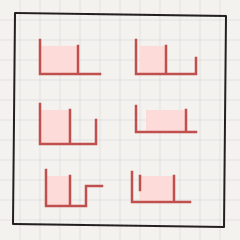 A — Options
The page of options
Five or six small studies of the same problem, side by side on one sheet. The fact that they are quick and small is the evidence, not the flaw. This is the page that shows there was a choice.
-
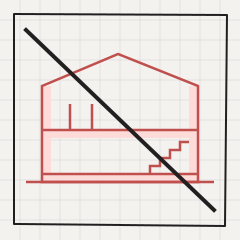 B — Dropped
The direction you dropped
The scheme you spent a fortnight on and abandoned. Keep every page of it. A direction you can show yourself rejecting is worth more than one you can only claim to have considered.
-
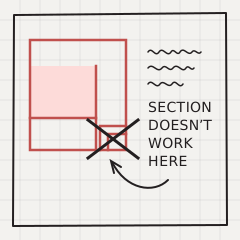 C — The turn
The page that explains the turn
The one with four words in the margin — section doesn’t work here — beside a heavy crossing-out. That note is the only record of why the project moved, and it exists on exactly one page in the world.
Swipe →
02Scan the whole book, not the good bits
The habit on the checklist is one line: keep all your sketches, especially the ugly ones. What the line does not say is when. The answer is on a schedule, not on a deadline. Every couple of weeks, the whole book from the last scan up to the page you are on, including the pages you would not show anyone.
Curating is a judgement, and in week three you do not have the information to make it. You do not know yet which of the four directions survives, so you cannot know which page turns out to be the one that explains the decision. Deciding what is worth keeping is a job for week eleven. Scanning is a job for week three. The two should never happen in the same sitting, because the week-three version of you will bin the page the week-eleven version needs.
One sitting, twice a month, in the calendar with everything else.
Do
Scan the book front to back on a fixed day. No decisions, no skipping, no stopping to look. A few minutes of turning pages.
Don’t
Scan the four pages you like. In week eleven the page you want is the one next to those four, the one with the crossings-out, and by then the book is in a box at your parents’ house.
03How to scan a sketchbook without buying anything
If the school has an A3 flatbed scanner, that is the best result available to you, and a spread goes through flat in a single pass. Ask at the print room desk in week one, not the week you need it.
Everywhere else, the phone does it. Not the camera app: a document-scanning app. That category of app finds the edges of the page, flattens the perspective and squares the page up, which is the whole difference between a scan and a photograph of a book taken at an angle. Nothing needs buying to get one. On an iPhone, the Notes app does it — new note, the camera button, then Scan Documents. On Android, Google Drive does it — the + button, then Scan.
Three things make the difference between a usable scan and a grey smear. Lay the book flat on a table, not on your knee. Light it evenly, which usually means a window rather than the ceiling light you are standing under, because the shadow you cast lands straight down the gutter. And shoot the whole spread rather than the single page, so the tape, the flap of tracing paper and the note in the margin stay attached to the drawing they belong to.
Then it goes in 03_sketches, inside the one project folder you made in week one, with the date at the front of the file name: 20261014_ORCHARD_sketchbook-p22-31.jpg. Date first, the same as every other file in that folder, so the scans sort themselves into the order they happened without you doing anything.
04One line at the top of the spread
Write the date and the question. At the top of the spread, before you start or before you turn over: 14 Oct — getting the stair out of the corner. Six seconds of writing, and it is the difference between a page of marks and a piece of evidence.
Without it, a page you loved in October is a set of grey lines in December that you cannot read and will not use. With it, the page arrives at the portfolio with its caption already written. You are not annotating for a marker. You are annotating for yourself in eight weeks, who will have forgotten more than seems possible.
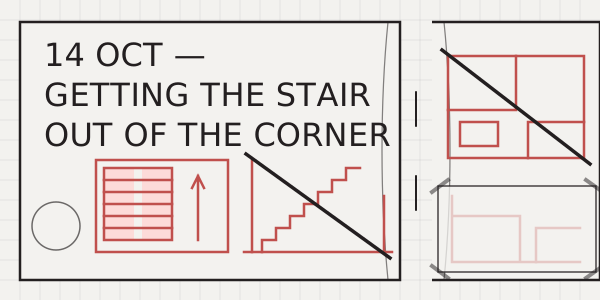
One honest note about how these look on a page. A sketchbook shot as a full spread — tape, coffee ring, crossings-out, the edge of the book visible — reads as something real that happened. The same page cropped to the drawing, straightened and cleaned up, reads as a graphic you made later. Both are true records. Only one of them looks like one, and the untidy version is doing work the neat version cannot. When those spreads go into the document at the end of term, run them large on the page rather than boxing and captioning them like a diagram. That is a decision about how the document is laid out, and it is one of the questions the portfolio template is asking.
Photograph the last fortnight of the book tonight, spread by spread, including the page you would not show anyone. It takes one sitting and it is the only version of that page that will still exist in April.