

A scheme that arrives finished looks like luck. A scheme with three abandoned versions behind it, each with a reason attached, looks like a decision. Only one of those can be shown, and only if you kept it.
01Process is an assessment criterion, not a courtesy
Go and read the criteria in your brief. Somewhere in them there will be a line about development, enquiry, iteration or process, and it will carry a weighting. That is check 02, the assessment criteria, and it is the reason this habit exists. You are not keeping rejected work out of sentiment. You are keeping the thing you will be asked to evidence.
Here is the trap. Process is marked, but process is invisible unless it was recorded, and recording it is a five-second job at a moment when you are not thinking about marks. You abandon the courtyard scheme on a Tuesday because it puts the studios in shade. On the Tuesday that reason is obvious, and you will obviously remember it. In week ten you remember that there was a courtyard, and you have a file called scheme_old.dwg that opens as a plan you no longer understand.
A recorded process cannot be argued with. A reconstructed one always can. A drawing produced in week eleven to look like week four reads as a drawing produced in week eleven.
02Export at the moment you abandon it
The habit is one action, done at one moment. When you stop working on an option, before you start the next one, export it.
For a CAD or Rhino drawing that is a PDF. File > Print > Print to PDF, or File > Export > PDF, whichever your setup gives you — the format matters less than the fact that it exists outside the working file. For a model, a photograph on your phone taken before you take the model apart. For a sketch, a scan or a straight-down photo on the desk. It costs about ten seconds, and it is ten seconds you will not spend again.
The reason for exporting rather than trusting the working file is that working files get worked on. You open scheme.3dm and you move a wall, because moving the wall is the next thing to do. The version you rejected does not survive that. It gets overwritten by the version that replaced it, silently, on a save you do not remember making. A flat PDF cannot be edited by accident.
03A version is the moment before a decision
Not every save is a version. If you keep every save you have a folder with two hundred files in it and no idea which four matter, which is the same problem as keeping nothing, arrived at through more effort.
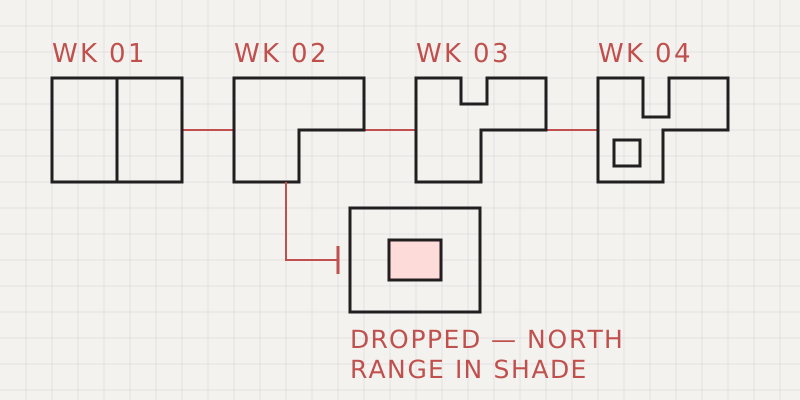
A version is the state of the drawing immediately before you changed your mind. Four or five per project is normal. The test is simple: could you say one sentence about why the next one is different? If yes, it is a version. If the answer is that you tidied the hatching, it is a save.
A variant is a different thing again. Versions run in time — this became that. Variants sit side by side — three answers to the same problem, drawn at the same moment. Both belong on a process page. A row of variants with a sentence under each reads as testing, a sequence of versions with the reasons between them reads as thinking, and a single perfect image with nothing around it reads as luck. Luck is not a criterion.
-
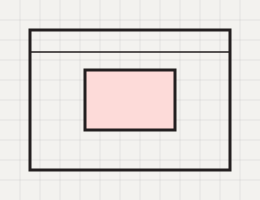 A — Rejected
The option that was dropped
Courtyard scheme, week four. The whole plan turns inwards around a court. Abandoned because the north range put the main studios in shade for most of the working day.
-
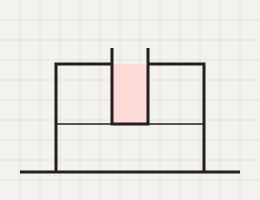 B — Adapted
The move it forced
Week six. The court survives as a cut through the roof rather than a hole through the plan. The move that killed option A is the move that produced the section everything else now hangs off.
-
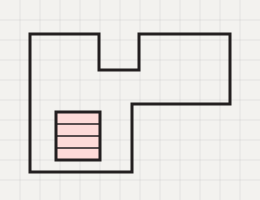 C — Final
Where it ended up
The rooflight over the stair is the courtyard, three decisions later. Shown on its own it is a rooflight. Shown after A and B it is an answer to a question you can name.
Swipe →
04Write the line now, because it becomes the caption
Every export gets one line of text with it, written the same day, in a plain text file in the same folder. Two halves: what changed, and why you moved on. Courtyard scheme. Dropped — north range shades the studios from about eleven onwards. That is the whole job.
That line is not admin. It is the caption, already written, seven weeks before you need it. Building process pages is slow because the drawings are quick to place and the words underneath take an hour each, and they take an hour each because you are reconstructing a reason instead of recalling one. Written on the day, the sentence takes fifteen seconds and it is true. When the pages get laid out — in the InDesign portfolio template, or in whatever you already use — the captions are already there.
The exports and the text file go in 99_archive, inside the one project folder you made in week one, and they never go anywhere else. Not the bin, not a Desktop folder called old, not left inside the working file as a hidden layer. One place, flat, searchable, and untouched until the week you build the process pages. That is also why the rule in that folder is that nothing gets deleted, it gets moved. This is the check that spends what that one saved.
In practice
If you are already deep in with no exports. Reconstruct from what exists and say so. Sketchbook pages, screenshots, an early file, a photograph of a pinned-up review — those are real records and they are enough to show what happened. Where you redraw something to make it legible, write “redrawn from the week three sketch” under it, and where you are describing a decision from memory, write that too.
Fabricated process work is obvious. It is too neat, it is in the wrong hand, and every drawing in it is at the standard of your best week. A gap you have named costs you a little. A reconstruction presented as a record costs you the benefit of the doubt on everything else in the document, and that is a much bigger bill. This habit is the seventh on the project-start checklist, and it is the one that pays back the latest and the most.
Open whatever you are drawing today, export the version you are about to change, and write one line beside it saying why. Do that at each of the next four moments you change your mind, and the process pages are finished before the project is.