

There is a document that tells you what you are being marked on. It was written before the project started, it is somewhere on the module page, and it is the last thing anyone opens. Usually in the week it stops being useful.
01Where the criteria live, and what to do if they are not there
Every module has one. It goes by a dull name — assessment criteria, marking rubric, assessment matrix, learning outcomes — and it is nearly always in one of three places.
The module handbook, in a section towards the back headed assessment. The brief, usually as an appendix after the deliverables list. Or the module page itself on Moodle, Canvas or Blackboard, under a heading like Assessment or Module information — sometimes as a separate PDF named something like ARC1001_marking_criteria_v2.pdf, sitting in a folder nobody expanded.
Look in all three before deciding it does not exist. Schools file it in different places, and the member of staff who uploaded it may have left.
If it genuinely is not there, ask once, in writing, of the module leader — module convenor, unit leader, whatever your school calls the person whose name is on the module. Not the visiting tutor in studio: they may never have been sent the document either. In writing matters because the reply is a record. Keep it to two lines: which module, where you have already looked, and a request for the criteria the work will be marked against. Then get on with the project.
Some schools also publish the professional criteria the whole course is validated against. Read those once, for context. They are not your mark sheet.
Nobody is hiding the marking scheme. It is published, in advance, in a document with a boring name, and it is still the least-read file in the project.
02The weightings tell you where your hours should go
Most criteria documents are a table. Criteria down the left, and beside each one a percentage, a weight, or a number of marks. That column is the useful half of the document and it is the half people skim past on the way to the adjectives.
Do this once, on paper. Rank the criteria by weight. Then rank the way you are planning to spend the next ten weeks. If the two lists come out in a different order, you have found the problem in week two instead of week eleven.
The arithmetic is unsentimental. A criterion worth ten per cent is worth an evening, not a fortnight. A criterion worth thirty per cent has to survive a marker going looking for it, which in practice means more than one drawing and more than one page.
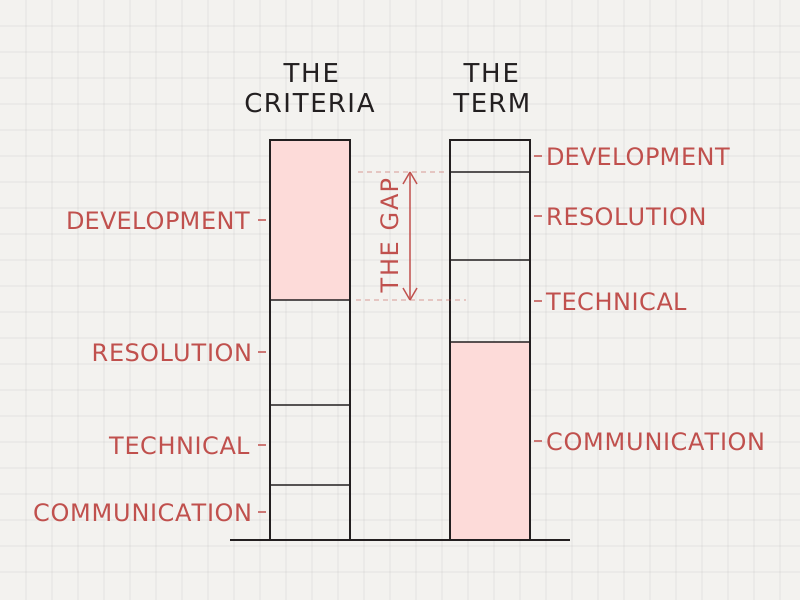
Two things go wrong at this stage.
The first is over-serving the part you enjoy. Renders, mostly. A render sits inside a communication or presentation criterion, that criterion is rarely the largest one, and the fourth day on it earns very little. I have spent three days on a stair render in a project where design development carried more marks than the whole presentation criterion, and the development pages were four sketches photographed on a windowsill.
The second is reading an unweighted list as if the order on the page were the order of importance. Some documents give no percentages at all, just four or five headed paragraphs. Where there is no weighting, treat the criteria as equal, and put the question in the same email as everything else you needed to ask.
03The verbs are instructions, and they are not about the design
Criteria are written in a particular kind of language, and the verbs are doing the work. They are telling you what has to be visible in the document, not how good the scheme has to be. A brilliant idea that a marker cannot point at scores the same as no idea.
- Demonstrate — a marker has to be able to put a finger on the page and find it.
- Evidence — bring the artefact, not the claim. A sentence saying you tested three options is not the three options.
- Critically evaluate — a judgement, in writing, including what did not work.
- Communicate — the drawing is what is being marked, not the intention behind it.
So “demonstrate an understanding of structure and construction” does not mean the structure works in your head. It means there is a section, a detail or an axonometric where a marker can see that you know how the building stands up. If that understanding exists only in a conversation you had in a tutorial, it is not in the submission.
Read each criterion and write beside it, in three words, which pages satisfy it. Where you cannot name a page, you have found either work still to do or a page still to draw. That list is also the outline of your drawing set. The InDesign portfolio template is being built to serve the last of those verbs: consistency earns nothing on its own, but an inconsistent document loses marks on communication.
04The criterion nobody serves, because it is invisible in a good drawing
Somewhere on that table there is a criterion called design development, or process and enquiry, or iterative design. It is usually weighted properly. It is the one students consistently under-serve, and the reason is simple: a finished drawing is evidence of a finished drawing. It says nothing about how you got there.
Markers cannot award development marks for work you did and did not include. The rejected option, the plan that was wrong for good reasons, the model that went in the bin, the sketch where the section finally made sense — those are the evidence. If they exist only as a memory, that criterion is being marked on an empty page.
This is why the habits matter more than they look. Keeping dated versions of a drawing as you go is what makes check 07 useful in December, and photographing sketches before the sketchbook fills up is the whole of check 11. Most of the twelve habits in the project-start checklist exist to keep the evidence this one criterion asks for.
In practice
If your course assesses process separately. Some schools submit development work as its own item — a workbook, a sketchbook, a process journal — sometimes marked in the room on the day rather than uploaded. Check which it is, because a sketchbook handed over in studio on the Monday is a different deadline in a different format from a PDF that uploads on the Friday, and it goes on your list of dates as its own line.
Go and find the criteria document now, before the design is far enough along to be worth defending. Print it, put it on the wall above the desk, and write the weightings large enough to read from where you sit.