

A scheme improves in your head for free. Drawings only improve at a desk, in hours you have to find, and there are never as many of those left as you thought in week two.
01Set the freeze now, while it costs nothing
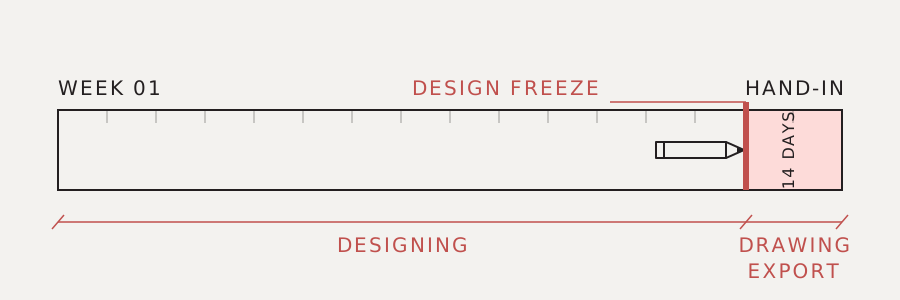
Two weeks before the submission, designing stops. Not slows down. Stops.
Pick that date at the start of the project, when it is still abstract and easy to agree to. Count back fourteen days from the hand-in and put it in your calendar as an all-day event with the same weight as the real one: DESIGN FREEZE — no new plans after today. Add an alert a week before, so the freeze arrives as something you were expecting rather than something that ambushes you on a Tuesday.
If you built one list of dates at the start of the project — the whole of the guide on when your work is actually due — the freeze goes in that list like any other line, with the source column reading me. That is the point. Your own deadline sits beside the university’s and is treated the same way.
Then tell somebody. A tutor, the person you sit next to, the group you are working with. A freeze you have announced is much harder to quietly move at midnight than one that only ever existed in your head. If you are in a group project, the freeze has to be agreed by everyone or it is not a freeze — one person still moving the plan moves everybody’s drawings.
02What the two weeks are actually for
The freeze is not two weeks of nothing. It is two weeks of the work that turns a project into a submission, and that work is slower than anyone expects because it is the part nobody has practised. Half of the project-start checklist exists to make this fortnight shorter — the folder, the file names and the saved versions all matter here, in the two weeks when you cannot afford to spend an evening hunting for a drawing.
-
Lock the drawing set
On the day of the freeze, write the full list of sheets: every plan, section, elevation, detail, model photograph, diagram and page of development work, in order. A fixed list on paper is what stops the scope moving. Anything not on the list is not being made.
-
Draft one drawing at a time, properly
Line weights, scale bars, north points, consistent hatching, the same graphic language on every sheet. Finish each drawing before starting the next. Half-finished drawings across twelve sheets is the state that eats the last weekend.
-
Write the captions and fix the page order
Every drawing gets a caption saying what it is, at what scale, and what it is showing. Then put the pages in the order that explains the project rather than the order you drew them in. Both jobs are quick and both are the first things dropped.
-
Export and print with a day in hand
File > Export > Adobe PDF (Print), then check the file against the portal’s size cap and open the exported PDF before you upload it. Print one full test set early. The InDesign portfolio template is being built with those presets tested at 10 MB, 5 MB and 2 MB, but the day in hand is the part that saves you.
03The freeze will feel like giving up, and it is not
This is the part everyone resists, so it is worth being honest about why.
An hour of designing in week eleven changes a scheme that exists in your head and in one Rhino file. An hour of drafting in week eleven changes the document that gets marked. The design hour feels more valuable because it is more interesting, and because a scheme in your head is always better than the one on the page. That is not evidence that it is worth more. It is evidence that unfinished things are flattering.
Most bad portfolios are good schemes that ran out of time. Nobody marks the scheme in your head. They mark the sheets that came out of the printer, and by then the difference between the two is entirely your problem.
There is a second, quieter reason the freeze is worth holding. Late design changes do not stay local. Move a wall two days out and the plan, the sections, the elevations, the model photographs and the render disagree with each other, and a marker reads that disagreement as carelessness rather than as a late improvement. A slightly worse scheme drawn consistently beats a better scheme drawn four different ways.
04When the scheme is not finished, freeze it anyway
It will not be finished. Almost nothing is at fourteen days out, and waiting until it is finished means never freezing at all.
So freeze what you have. Draw the version that exists on the day, including the parts you are not sure about. Then, at the end of the document, say plainly what you would do next and why: two or three sketches and a short paragraph on the question you had not resolved and how you would test it.
That page is not an apology. It is markable material. The criteria for almost every project contain a verb about evaluation or reflection — that is what the guide on reading the assessment criteria is about — and a student who can name the weakness in their own scheme is demonstrating exactly the judgement that verb is asking for. A student who quietly hopes nobody notices is not.
The one thing that does not work is the middle position: still moving the design, still hoping to draw it, drawing neither properly. I have printed a portfolio at six in the morning containing a plan I changed at two. The plan was better. The captions were in the wrong order, three sections showed the old wall, and nobody in the room was looking at the plan.
Do
Freeze the scheme on the date you set, then spend fourteen days drafting, captioning, ordering, exporting and printing. Put the unresolved question on a page of its own and answer it in words.
Don’t
Move the plan two days out because it is nearly right. You will not have time to update the sections, and a set of drawings that contradict each other reads as carelessness, whichever version was better.
Open your calendar, count back fourteen days from the submission, and put the freeze in before you close it. Then go and tell one person the date, so that in week eleven it is not only you holding the line.